


When Ian Porter first stepped into a race car in early 2024, he knew he couldn’t stay the way he was. The RAFA Racing Team driver, now IMSA VP Racing SportsCar Challenge Bronze champion, was 260 pounds, “skinny fat” in his words, with the build of a professional gamer, not a professional racing driver.
He still remembers the wake-up call.
“It was like February at Sebring, maybe 50, 55 degrees,” Porter says.
“The AC in the car was working perfectly, and I was still sweating my ass off after like 30 minutes. That’s when I went, okay, I really, really have to change this.”
From that moment, he treated his body the same way he treats his driving: as a performance project with no shortcuts and no excuses.
When Porter started, the scale read around 260. By the end of last year, he had cut that to about 215. This season, he’s taken it down again, sitting at roughly 185 pounds. The next target is already set: 170 before the start of next season.
“I didn’t want to take Ozempic, I didn’t want to do shortcuts,” he says. “It wasn’t just about losing fat. I needed to build muscle and actually evolve physically. Racing is just too demanding to fake it.”
He compares a race to putting on full ski or snowboard gear inside a sauna, then trying to solve a Rubik’s Cube with your life on the line. You’re seated, but you’re burning around 1,000 calories in a single race, and the mental drain quickly becomes physical.
“People think you’re just sitting down, but it’s insane,” he says. “And on top of that, every pound you carry is slowing your lap time. So fitness isn’t optional. It’s time in your pocket.”
For Porter, the foundation of his transformation is almost painfully simple: burn more calories than you eat.
“To me, that’s it,” he says. “Burn more than you eat, and you will lose weight. People get hung up on ‘good’ and ‘bad’ foods or saying you shouldn’t do cardio if you want to lose weight. I’m like, what the hell are you talking about? Just hit the numbers.”
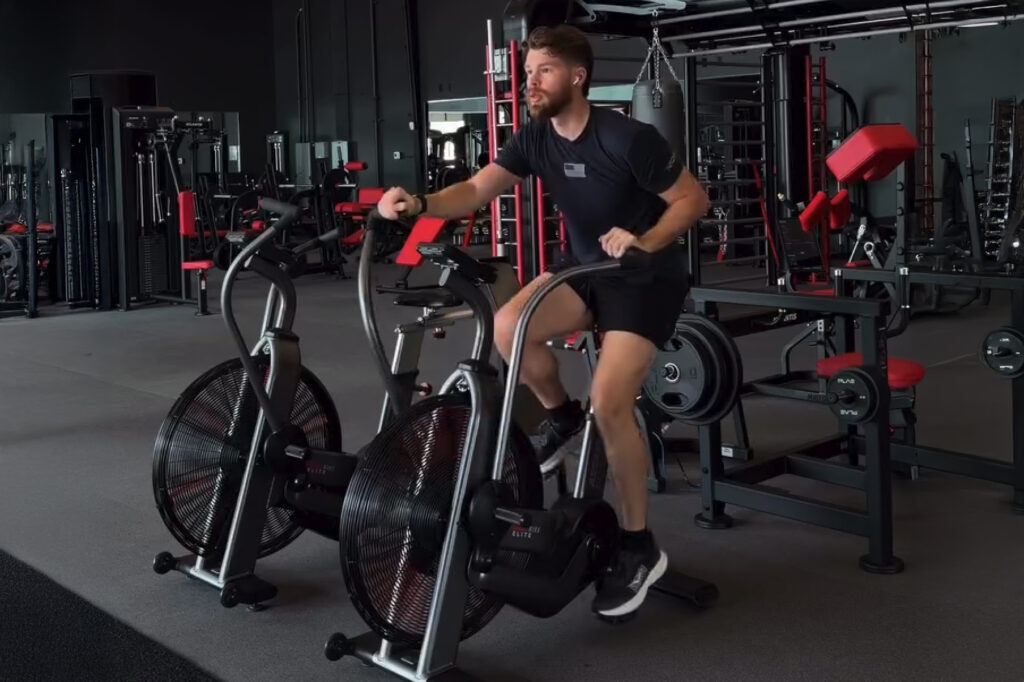
At home, he lives on a strict calorie deficit, usually around 1,850–1,900 calories a day. He structures his training around high-intensity circuits: six different exercises, four sets each, aiming for 700-1,000 calories burned per day.
“I’ve found 700 calories is the sweet spot for me,” he explains. “If I burn 1,000, yeah, I’ve technically burned more, but then I’m starving, and I end up eating like 600 extra calories. At 700, I can stay consistent with about 1,900 calories of food. It’s all about something you can do every day.”

The recently opened RAFA Performance Centre has become a key weapon. With access to proper equipment, a structured environment, and even time in the sauna, his training has become more focused and more professional.
“That’s pretty much my everyday now,” he says. “Massive high intensity interval training circuits, watching the calories burn, big calorie deficit. It’s not glamorous, but it works.”
There is one place where he bends his own rules: race weekends.
“That’s my one exception,” he says. “On race weekends, I’m not tracking calories. I’ll eat whatever I need to feel good. The last thing I want is a hunger headache in the middle of a race. That would be a complete disservice to all the work I put in. Performance comes first, everything else is secondary.”
Most race weekends, he comes home a bit heavier, not lighter. And he’s completely fine with that.
The other key piece of the puzzle is data. Just as there are sensors all over the car on track, Porter has wrapped his own body in technology. He wears a WHOOP band every day and through every race, tracking his calories, strain, and heart rate zones.
“The WHOOP has been a game changer,” he says. “I know exactly how many calories I’m burning, day to day and in the car. When I first started racing, I’d be in Zone 4 which indicates I’m really over-exerting myself just to drive, sometimes Zone 5, every race. Now, at places like Road Atlanta, I’m barely in Zone 3.”
To him, that’s proof that his body and brain are adapting to the stress and speed of professional racing.

“It’s like my eyes, my brain, my whole system is getting used to how fast everything is happening,” he says. “The races are starting to feel more like second nature, which is wild.”
That extra physical capacity translates directly into more mental bandwidth. Instead of just hanging on and keeping the car between the white lines, he has space in his head to think, manage tires, and make decisions.
“You want that spare mental capacity,” he says. “The fitness helps you get there.”
RAFA’s own behind-the-scenes content has also given Porter an unexpected way to measure progress. Watching early footage from Season 1 of the team’s TV-style series is like looking at a different person.
“It’s funny watching that stuff,” he says. “I’m almost unrecognizable compared to where I’m at now. It’s a great feeling, because I know exactly what went into that difference.”
None of it has happened in a vacuum. As the RAFA Racing operation grew in 2025 and the expectations rose, the pressure around him increased—and that’s exactly how he likes it.
“The expanded team brings massive expectations,” he says. “You’re repping your name, your brand, and they want to win every race. That’s how I’ve always thought. I almost need that external pressure. I need someone pushing me past what I think is possible.”
Looking at how much progress he has made—on the stopwatch and on the scale—Porter doesn’t think he could have done it alone.challenge, but it is one that both Jem and I are really looking forward to.”

“The gap I closed from the start of the season to the end, I don’t think it would’ve been possible without Kevin (Conway) and the rest of the team,” he says. “They don’t really praise me for improving, they just keep me on my toes: faster, faster, faster.”
Now, with a VP Racing SportsCar Challenge Bronze title on his résumé and his body finally matching his ambition, his goals are only getting bigger. He talks openly about wanting to bring home multiple trophies for RAFA next year and chasing overall results, not just class wins.
“That’s kind of my thing—setting unrealistic goals and going after them every single day,” he says. “I don’t know if I’ll reach all of them. But I’m going to try.”
For a former professional gamer who once thought he was at the top of the world in track days and sim racing, only to be humbled by just how hard real-world racing really is, this transformation has become the defining challenge of his life.
“Playing first-person shooter games is like walking to me,” he says. “Driving was not like that at all at the beginning. It was the hardest thing I’d ever done. But now, with the fitness, the weight, the data, and the sim work, it’s finally starting to feel like second nature.
“It’s been the hardest thing I’ve ever done physically. But man, the payoff is unbelievable.”


