

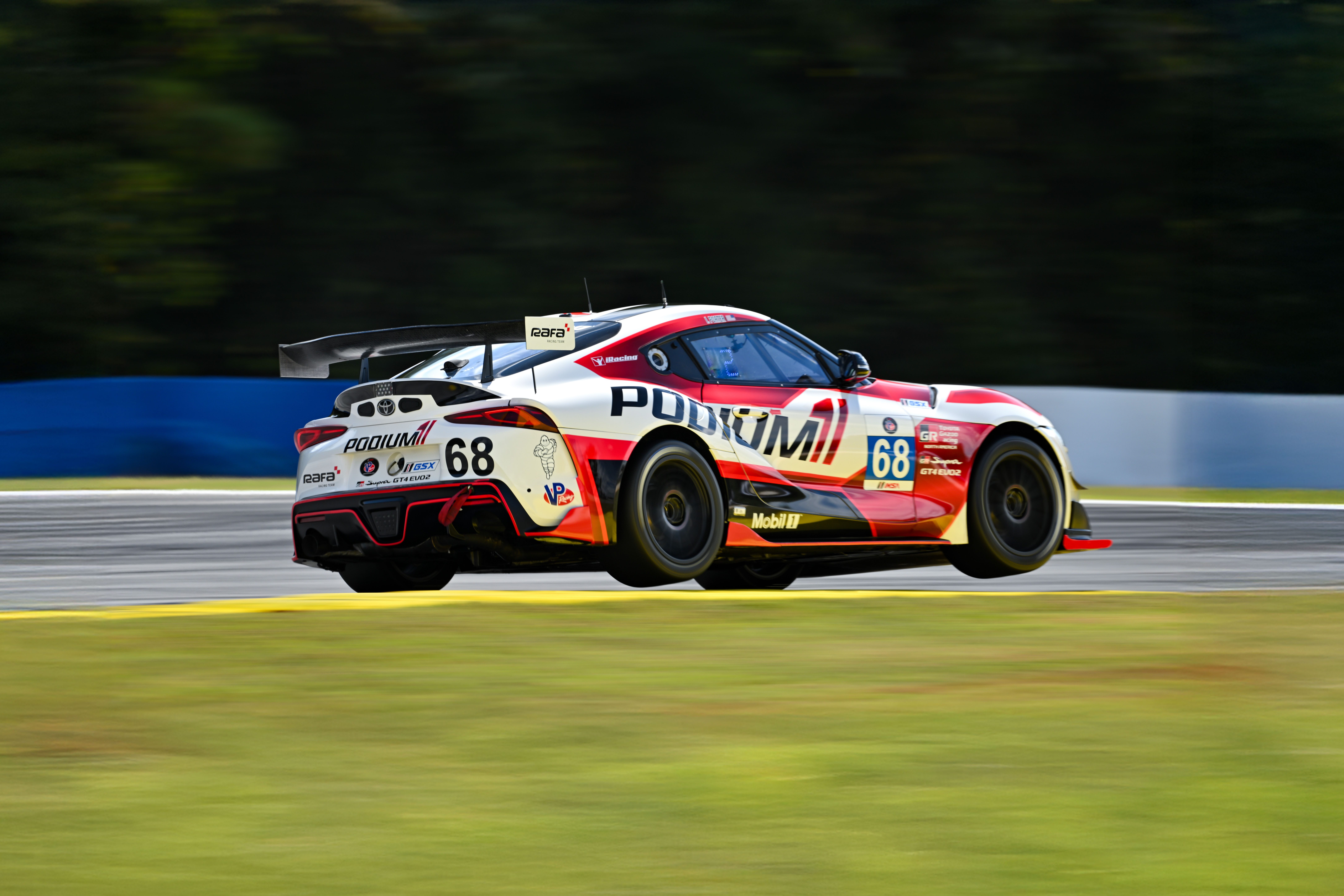
RAFA Racing Team driver Ian Porter, a three-time Call of Duty World Champion, capped his first full season in the VP Racing SportsCar Challenge by winning the Bronze Championship, marking another milestone in his transition from virtual racing to real-world success.
“The biggest challenge was definitely stepping up in terms of competition and who I was going against,” Porter said.
“The second challenge was understanding a completely new car—car, tires, and tracks as well. I think there were only one or two tracks out of the seven rounds that I’d ever raced before, so five out of seven I had no idea what I was doing.”
He said the atmosphere was significantly different from his debut season.
“The higher level of competition was definitely a big step up, and the atmosphere was completely different from last year,” he said. “Last year was more laid back—people were doing it for fun. This year, it was full-on professionalism, and it felt like do or die.”

Pushing to match his teammate
Porter’s main benchmark all season was his teammate, Kiko Porto – the eventual overall series champion.
“The biggest challenge was probably just trying to keep up with my teammate Kiko and keeping up with the expectations of my performance as a driver from Kevin and the rest of the team,” Porter said.
“Even though Kiko has been doing this pretty much his whole life and there’s no way I should be able to beat him—that’s what part of my brain is telling me—the other side of me absolutely wanted to beat him every single race,” he continued.
“I don’t care if you expect me not to win, because in my head, I’m going to try my absolute best to win every single race. Even if I fail—race after race, practice after practice, qualifying after qualifying—those failures didn’t really deter me from achieving my maximum limit of going as quickly as possible.
“If you want to improve, you have to set unrealistic expectations, and you have to strive for those in every single moment.”

Finding speed through shared data
Having a fast teammate to share data with was certainly a bonus for Porter, but he wasn’t the only one to take advantage of the extra reference points available.
“When we were two-tenths off each other—which from pretty much Mid-Ohio onward is where the gap was—it was tough to identify,” Porter said.
“It got to the point where I would help Kiko in some areas and he would help me in others. We were using each other’s data to drive faster.
“I would fix the things that would make me faster, but then Kiko would use my data to improve his own speed so that the gap would remain the same.”

Adjusting to the mixed field
In his first full season of competition, Porter was unstoppable in the Cayman class in Porsche Sprint Challenge North America – charging on to a series championship win.
“To be honest, this year felt like Porsche Sprint Challenge all over again because my only real competition was the Supras,” Porter said.
“I didn’t have to worry so much about the BMW or the Cayman or the Mercedes advantages and disadvantages because they were never really even close to us at the front. That’s still a box left unchecked for me—multi-manufacturer racing.
“I really wish there was stronger competition from other cars. I feel like it would have made for a more exciting year, but the Supra drivers were just fast.”

Favorite tracks and battles
Among a calendar full of new experiences, a few tracks left a lasting impression on Porter.
“My favorite was probably Road Atlanta,” he said. “I really liked pretty much all of them, but of the new ones, my best was probably Mid-Ohio.”
He also enjoyed the challenge of Canadian Tire Motorsport Park.
“Everyone was saying it’s one of the scariest tracks, but to me it didn’t feel scary at all,” he said.
“I had a lot of fun at CTMP, and I think the longest, best battle I’ve had—going car to car and door to door—was in Canada, where Clemons and I basically battled for a lap and a half straight, side by side. I was kind of bummed when they canceled the second race for Canada because that track to me was pretty awesome.”

Growth within RAFA Racing Team
Porter credited the team’s growth and structure for helping him raise his own performance throughout the season.
“The birth of the RAFA Racing Team this year brings a massive expectation: you’re repping your own name, you’re repping your brand, and they’re applying that pressure to perform. They want to perform in every single race,” Porter said.
“That’s how I’ve always thought, and that’s how I felt in video games—that’s how I think now when it comes to racing.
“Last year, it was just me thinking that. There was no external pressure—it was all internal. I’m one of the people who thrives under pressure. I almost need that external force pushing you past what you think’s possible.
“The gap that I closed from the start of the season to the end—how much faster I got—wouldn’t have been possible if it wasn’t for Kevin (Conway) and the rest of the team pushing me along that route.”

From gaming to racing
Porter’s journey to professional racing hasn’t been a straight line. Long before his first championship, he spent years on track days and in sim racing leagues, learning just how far he had to go.
“Five years ago, when I was doing track days, I thought I was awesome,” Porter said.
“If you told me five years ago that I’d be racing professionally with two championships behind my belt, I would have said, yeah, that’s expected. But if you go back three years ago—where I was in the sim racing pro leagues—I’d be like, really? I completely suck!
“Going from track days to that sim racing pro league was the biggest eye-opening moment of my life because I realized I wasn’t anything special.
“The challenge of driving quickly and seeing the gap from where I was compared to the best in the world was so immense that I’m like, if I get this done, this is by far the hardest thing I’ve ever done—harder than any Call of Duty tournament or anything video game related, because playing a first person shooter game to me is like walking. Driving is not that way—at least to me. Now it’s sort of getting to the point where it is second nature.”

The simulator advantage
Porter’s preparation happens long before he straps into the car, with hours spent in the simulator forming a crucial part of his routine.
“At this point in my racing career, I’m two years in, and I’ve had a total of two or three test days at all the racetracks in North America,” Porter said.
“Being able to win at a track after going there for your first time—at the actual race weekend—is pretty insane to me. Without the help of iRacing and Podium One, I don’t think I’d have any trophies.
“iRacing truly is a fantastic platform to learn not only how to drive quickly, but also to know the tracks you’re going to be racing on in real life. In my experience, it’s almost 95 percent as real as it gets.
“In real life, curbs will puncture tires, and little things like braking offline—you don’t really slow down in real life, but in the sim, if you brake offline, you stop in the same spot.“Testing in real life can be $20,000 a weekend, or I can just put in 20 hours on the sim,” he said.
“I truthfully think it would be more productive to spend 20 hours on the sim than one weekend at the track. Which is insane to think about, because we’re using a video game to practice for real life.”


